Mattress Guides
Adjustable Bed Foundations: What to Check Before Choosing a Mattress
An adjustable bed base can lift the head or legs with a quiet change in angle, transforming a flat sleep surface into something more adaptable. But the base and mattress must work as a pair. Before choosing either, check how the mattress bends, what support the base provides, and whether the manufacturer approves the combination.
An adjustable base makes a bed move. Motors raise or lower sections of the platform, changing the angle beneath the sleeper. The movement may be subtle—a slight lift at the head—or pronounced, with the upper body and legs resting at different elevations. For the mattress, each adjustment is a small mechanical test: it must flex without buckling, stay positioned on the deck, and continue to support the body as its shape changes.
That is why mattress compatibility is more than a question of whether a mattress can bend. Construction, thickness, flexibility, weight, and the base’s design all matter. A mattress that works well on a stationary foundation may not be suitable for every adjustable bed. And a base that fits a room may still be the wrong choice if its dimensions, capacity, or movement range do not match the mattress and the people using it.
A measured approach can prevent costly surprises. Start with the mattress maker’s guidance, then compare the base specifications, the bed’s intended use, and the practical details of delivery and setup. The goal is not simply to make a mattress move; it is to preserve stable, comfortable support through repeated movement over time.
Begin with the mattress manufacturer’s guidance
Before comparing motors or presets, look for a clear statement from the mattress manufacturer about adjustable-base use. Some mattresses are expressly designed to flex with an adjustable foundation. Others may be approved only for certain base types, or may have restrictions tied to thickness, construction, or warranty coverage. If the guidance is missing or unclear, ask the manufacturer directly and keep the answer with your purchase records.
Compatibility statements are important for two reasons. First, not every mattress responds to bending in the same way. Second, using an unapproved foundation may affect warranty eligibility, even when the mattress appears to fit and function at first. Warranty terms vary, so check the actual document rather than relying on a retailer’s general description or an assumption that all modern mattresses are adjustable-base compatible.
When asking questions, be precise. Give the manufacturer the mattress model, its dimensions and thickness, and the make or specifications of the base you are considering. Ask whether the pairing is approved, whether there are limits on the angle or type of articulation, and whether the mattress must be used with particular support requirements. A written response can help clarify details that a brief product listing leaves out.
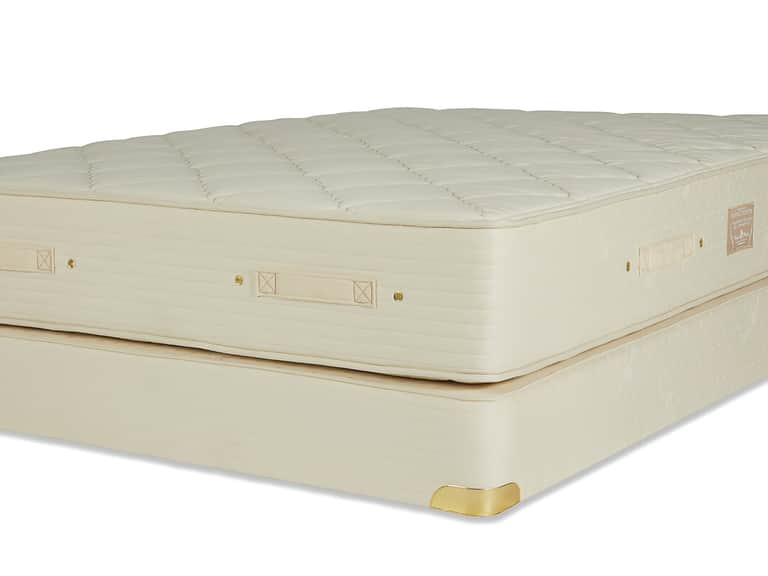
For example, the product information for the Royal-Pedic Premier Natural Latex Quilt-top Mattress states that the mattress may be used on an adjustable bed base. That is useful information about this particular model, not a general rule for every latex mattress. A material label alone cannot confirm compatibility: construction and manufacturer approval still need to be considered.
How mattress construction affects movement
An adjustable platform changes the support beneath a mattress at several points. As the head or foot section rises, the mattress bends along the base’s hinge areas. Its layers must follow that movement while staying joined and supported. Some designs can flex readily; others may resist articulation, form a sharp fold, or feel noticeably different when elevated.
Foam and latex mattresses are often discussed as flexible options, but the category name is not enough to predict performance. Layer arrangement, firmness, density, cover construction, and overall thickness all influence how a specific mattress responds. A thick mattress, for instance, may be more difficult for a base to bend than a slimmer one, but thickness by itself does not settle the question. Follow the model-specific guidance.
Innerspring mattresses also vary. Pocketed coils, connected coil systems, edge supports, and comfort layers can behave differently as the mattress moves. Some models are built and tested for adjustable foundations; others are intended for flat support. A construction that feels responsive when lying flat does not necessarily articulate smoothly. Check the manufacturer’s compatibility statement instead of trying to infer it from the product’s name or appearance.
Pay attention to the mattress cover and any added layers, too. A snug protector or fitted sheet should not prevent the mattress from moving, but an unusually tight cover, bulky bedding, or a topper that shifts can interfere with a clean bend. If you plan to use a topper, confirm that it can accommodate the base’s range of motion and that it will stay in place safely.
Check thickness, dimensions, and weight
Mattress thickness affects the space available to flex and can influence how the bed feels when raised. A thicker profile may be heavier and less pliable, while a thinner one may bend more readily; neither observation is a substitute for the manufacturer’s limits. Compare the mattress’s exact thickness with the base’s stated compatibility range, if one is provided. Include any permanent pillow-top or integrated comfort layer in the measurement.
Next, confirm that mattress and base dimensions match. A mattress that is too narrow, too long, or otherwise mismatched can move unevenly or leave unsupported areas. Standard size labels are a helpful starting point, but verify actual measurements—especially for split configurations, less common sizes, or older bed frames. Make sure the base will also fit the room, pass through doorways and stairwells, and leave enough clearance for movement and access.
Weight capacity deserves equally careful attention. The base’s total supported load generally needs to account for the mattress, the people using it, and anything else the manufacturer says to include. In a split setup, determine whether the stated limit applies to each side separately or to the complete frame. Do not assume that a base with a larger-looking frame necessarily has a higher capacity; consult its specifications.
Consider how weight is distributed as well as the total. A mattress that is heavy or difficult to maneuver can make installation challenging, and an uneven load may affect how smoothly the base operates. If the manufacturer specifies a maximum mattress weight, minimum or maximum thickness, or other setup conditions, treat them as part of the compatibility check rather than optional recommendations.
Understand the base’s support and movement
Adjustable bases differ in the sections they move, the angles they can reach, and the support they provide beneath the mattress. Some raise the head and foot independently; others offer a more limited range. Certain models include presets or additional functions, but more features do not necessarily mean a better fit. Choose based on the positions you expect to use and the mattress’s approved movement range.
Look closely at the platform that supports the mattress. Check the surface design, the spacing of any slats or support elements, and whether the manufacturer requires a specific kind of deck. The mattress should have appropriate, even support in both flat and elevated positions. If the base uses a frame or legs that require assembly, confirm that it will sit securely on the intended floor and that every support point is installed as directed.
Also consider the transition points—the areas where the base bends. A mattress must move with those sections rather than being forced into a fold it cannot tolerate. Ask whether the base is designed for the mattress type and thickness you have chosen, and whether a particular orientation is required. Some mattresses have a designated head and foot; others may be rotated or flipped according to their care instructions. Follow the mattress maker’s directions.
The base’s movement should remain clear of nearby furniture, walls, cables, and stored items. Leave the clearance recommended by the manufacturer, and do not place objects beneath moving sections unless the design specifically allows it. A bed that has room to articulate without obstruction is more likely to operate as intended and less likely to snag bedding or surrounding objects.
How the mattress is held in place
As a base tilts, gravity can pull the mattress toward the lower end. Many adjustable foundations use a retainer bar, raised platform edges, or another restraint to limit sliding. Check what is included and whether the retention system is appropriate for the mattress’s dimensions and thickness. The mattress should remain aligned without being pinched, distorted, or forced against a component that is not designed to contact it.
Ask how the mattress is secured during use and whether the restraint can be removed for setup or service. If the base relies on friction or a particular surface texture, make sure that the mattress cover and any topper will not undermine that arrangement. Avoid improvised straps or modifications unless the base manufacturer approves them; an added attachment could obstruct movement or damage the mattress.
Fit the sheets and bedding after checking the mattress’s position. Deep-pocket sheets may be needed for some mattress-and-topper combinations, but a sheet that is too tight can pull at the corners as the bed bends. Keep blankets and cords clear of moving joints, and check that the bedding does not become trapped between the mattress and the base.
Comfort can change when the bed moves
A mattress may feel different when angled than it does when flat. The body’s weight shifts across the surface, and the mattress bends at the base’s articulation points. A position that reduces pressure in one area may create a different sensation elsewhere. This does not necessarily indicate a problem, but it is a reason to test the complete setup when possible and to allow time to assess it in the positions you intend to use.
Consider your usual sleep position and the purpose of the adjustment. Someone who primarily sleeps flat may use only occasional elevation. Another person may raise the upper body while reading or resting. These different patterns affect how frequently the mattress bends and which sections experience movement. Choose a base whose practical range fits your routine, rather than selecting features solely because they are available.
Partners should consider whether they need independent adjustment. A split configuration can allow each side to move separately, but it may require two compatible mattresses or a design specifically made for that arrangement. Check the combined dimensions, the gap or boundary between sides, and how sheets and bedding will fit. Confirm that each mattress is approved for its corresponding base section.
Comfort is personal, and an adjustable foundation is not a treatment for a medical condition. If you have persistent pain, breathing concerns, or another health issue that affects sleep, consult a qualified health professional for individual advice. Product specifications can describe a bed’s operation; they cannot determine what position or setup is medically appropriate for a particular person.
A practical checklist before you buy
Gather the relevant details before placing an order. Comparing the mattress and base side by side can reveal a mismatch that is easy to overlook when their specifications are on separate pages. Use this checklist as a starting point, then confirm any model-specific requirements directly with the manufacturers.
- Compatibility: Does the mattress manufacturer explicitly approve the mattress for adjustable-base use?
- Warranty: Do the mattress and base warranties allow the intended combination, and are there conditions to preserve coverage?
- Dimensions: Do the mattress and base have matching size and actual measurements?
- Thickness and weight: Is the mattress within the base’s stated limits?
- Construction: Does the mattress maker identify any restrictions related to materials, layers, or orientation?
- Movement: Does the base provide the positions and range of motion you are likely to use?
- Support: Does the deck provide the required, even support beneath the mattress?
- Retention: How is the mattress kept from sliding as the platform tilts?
- Clearance: Will the base move freely without hitting walls, furniture, bedding, or stored objects?
- Delivery and assembly: Can the base and mattress be brought into the room, assembled, and serviced safely?
- Care: Are there special instructions for rotating, flipping, cleaning, or moving the mattress?
If any answer is uncertain, pause before ordering. A short call or email can be more useful than relying on a broad claim such as “works with most beds.” Keep product documents, receipts, and written compatibility guidance together so you can refer to them during setup or if a warranty question arises.
Setup and first-use checks
Follow the base’s assembly instructions in sequence, and use the recommended number of people to lift or position heavy components. Before adding the mattress, check that the frame is stable, the legs and fasteners are secure, and cables are routed away from moving parts. If the product includes a power supply or remote, use it as described by the manufacturer and keep electrical connections accessible.
Place the mattress in the specified orientation and install the retainer or other restraint exactly as directed. With the area clear, operate the base through its movement range while watching for contact with the frame, wall, bedding, or cables. Stop if the mattress shifts substantially, catches, or appears to fold unnaturally. Recheck the setup and contact the manufacturer if the behavior continues.
Once the bed is in use, pay attention to changes in position and feel. A small adjustment to bedding may be all that is needed if sheets pull or a topper drifts. Persistent sliding, unusual noises, uneven movement, or visible damage should not be ignored. Follow the troubleshooting instructions and avoid opening or modifying electrical or mechanical components unless the manufacturer authorizes that work.
Plan for maintenance and longevity
An adjustable base introduces moving parts to a piece of furniture that might otherwise remain still. Periodically inspect the bed according to its care instructions, looking for loose connections, obstructions, or wear. Keep the area beneath the base free of objects that could interfere with movement, and clean the frame only in the manner recommended by its manufacturer.
Mattress care still follows the mattress maker’s directions. Some mattresses can be rotated; others have a defined top and bottom and should not be flipped. A base’s movement does not change those instructions. If the mattress has been compressed during delivery, allow it to expand as directed before operating the foundation, where applicable. Do not bend, fold, or carry a mattress in a way the manufacturer prohibits.
Over time, notice whether the bed moves smoothly and whether the mattress remains centered. Changes may arise from a loose setup, an obstruction, or ordinary wear, but diagnosis should follow the product guidance. Maintaining the system as a pair—mattress and foundation—helps protect both comfort and function.
The right pairing begins with the details
An adjustable bed can make a familiar mattress feel like a more responsive part of the room: the head rises for a book, the legs lift for a moment of rest, and the flat plane becomes a sequence of possible positions. That flexibility depends on a foundation designed to move and a mattress that is approved to move with it.
Start with manufacturer guidance, then verify construction, thickness, weight, dimensions, support, retention, and warranty conditions. Consider how the bed will be used, not just what it can do. When these details align, the base and mattress can operate as a coordinated system—one that bends deliberately, stays secure, and supports the sleeper through both movement and stillness.