Mattress Guides
Reading Organic Mattress Labels: Materials, Certifications, and Caveats
The word “organic” on a mattress label can describe a particular fiber, a single layer, or a documented step in production—not necessarily every component in the bed. To understand what a claim means, look beyond the headline: identify the material, find the certifying organization, and check exactly what the certification covers.
Published October 25, 2026
A mattress is less a single object than a small landscape of materials. Beneath its fabric cover may be latex, foam, springs, wool, cotton, adhesives, fire barriers, and other components. Each has a different origin and function, and each may be subject to different standards. That complexity is why the label “organic mattress” deserves a closer reading.
In everyday language, “organic” can sound like a simple description of the whole product. On a mattress label, it may instead refer to a specific agricultural material or a component that has been certified according to a particular standard. A cover might contain certified organic cotton while the comfort layers, adhesives, or other materials have not been certified under that same program. Conversely, a certification may apply to a defined product or process, but its scope still needs to be checked.
Careful label reading is not an exercise in suspicion. It is a way to turn broad promises into useful details. When a claim is specific, supported, and clearly bounded, shoppers can better compare materials and decide which qualities matter to them.
Start by separating the claim from the product
Begin with the exact wording. “Organic cotton cover,” “made with organic materials,” and “organic mattress” are not interchangeable descriptions. The first identifies a particular material. The second signals that organic materials are included but does not, by itself, reveal their proportion. The third may suggest a broad product-level claim, yet the label or supporting documentation should explain what that means.
Look for nouns as well as adjectives. Is the claim about cotton, wool, latex, a cover, a filling, or the complete mattress? Then look for quantities or boundaries: does the company say which layers are covered, identify the source of the claim, or provide a certificate number or documentation? If the wording leaves these questions unanswered, treat it as a starting point for inquiry rather than proof of a whole-product attribute.
Useful details often appear away from the most prominent marketing language—in a materials list, a certification directory, a care guide, or a technical specification. Read the product page and label together. One may summarize; the other may define. If a company makes an important claim but does not explain its scope, ask customer service for documentation that names both the material and the standard.
- Identify the material: Is the claim about latex, cotton, wool, or another component?
- Identify the location: Does it apply to the outer cover, a filling, a comfort layer, or the whole mattress?
- Identify the standard: Which organization or certification program is named?
- Identify the evidence: Is there a certificate, current listing, or other documentation that can be checked?
What “organic” can mean for mattress materials
Organic claims usually have their clearest meaning when they identify an agricultural raw material and a standard governing its production or processing. Cotton and wool, for example, are fibers grown or raised within agricultural systems. Latex begins as sap from rubber trees and is processed into a usable material. The relevant standards and documentation can differ by material, country, and stage of production.
Cotton and wool
For cotton, check whether the claim applies to the fiber used in the cover, batting, or another component. A mattress described as having an organic cotton cover does not automatically have organic cotton in every layer. For wool, ask which part of the mattress uses it and what certification or sourcing claim is being made. Do not assume that one certified fiber makes all other contents organic.
Latex
Latex descriptions call for particular care because terms such as “natural,” “natural latex,” and “organic latex” can appear close together in marketing. They do not necessarily communicate the same thing. “Natural” may describe an origin or material category; it does not, alone, establish that the material is certified organic. A latex layer may also be blended or processed, so ask what the product specification says about composition and which portion a certification covers.
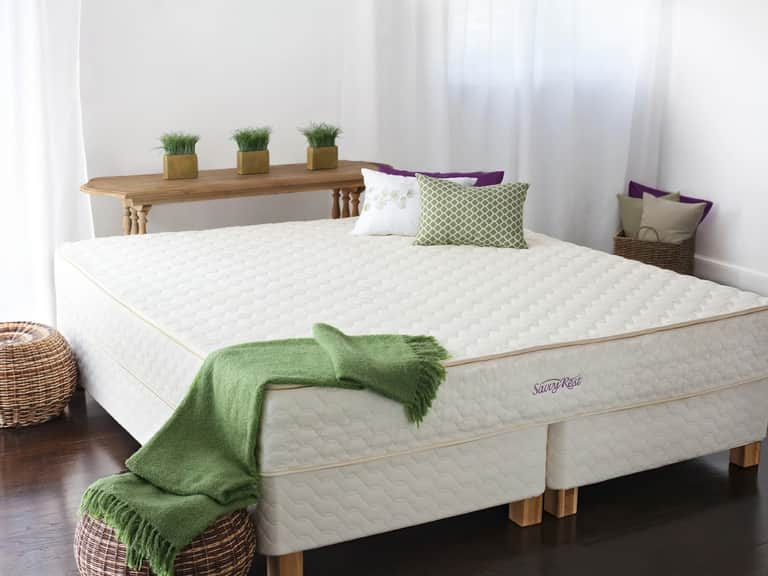
For example, the Savvy Rest Serenity Latex Mattress is described as using organic cotton, organic wool, and Dunlop and/or Talalay latex. Its listing states that the latex is certified organic and names GOLS, while also describing customization across layers. This illustrates why it helps to read the component details alongside the certification claim: a mattress can contain several materials, and a claim about latex should not automatically be extended to every part of the finished product. Confirm current documentation and the exact configuration with the manufacturer before relying on a claim.
Other layers and construction materials
A mattress may also include steel springs, synthetic or blended foams, thread, adhesives, flame-resistant components, and upholstery materials. These parts may be addressed by different safety or environmental standards, or may not fall within an organic agricultural certification at all. A product can therefore combine certified materials with other materials that have their own descriptions and requirements. The meaningful question is not simply whether a mattress is “organic,” but what is known about each significant component.
Certifications: useful signals, not blank checks
A certification is most useful when the buyer can establish three things: who issued it, what standard it follows, and what product or material it covers. A recognizable name or logo may be a useful lead, but a logo alone cannot tell you whether the certification applies to the finished mattress, one component, a manufacturing process, or a facility.
Different programs address different questions. Some focus on whether a material meets organic production and processing requirements. Others assess chemical emissions, restricted substances, or environmental and social criteria. These are not interchangeable goals. A certification related to emissions, for example, should not be treated as proof that a material is organically grown. Likewise, a claim about organic fiber does not necessarily answer questions about emissions or every chemical used elsewhere in production.
When a label names a standard, visit the certifier’s own website or public directory where available. Search for the company, product, or certificate information, and check whether the listing is current. If the directory does not list finished consumer products, ask the manufacturer what certificate applies to the relevant material and request its scope. A supplier certificate may establish something about a raw material or facility without certifying the completed mattress as a whole.
Certification does not settle every practical question, either. It does not tell you whether a mattress feels comfortable, suits your sleeping position, fits your foundation, or will remain supportive for years. Those are separate questions that require construction details, warranty terms, testing where available, and a return or exchange policy.
The caveats behind familiar label language
Marketing language often compresses a complicated supply chain into a few reassuring words. A close reading helps restore the missing context.
“Natural” does not necessarily mean “organic”
Natural may refer to a material’s origin or be used as a general description, but it does not automatically indicate certification, composition, or processing method. Ask what the term means in that specific product description and whether the company can substantiate it.
“Made with organic materials” does not specify a percentage
The phrase tells you that organic materials are present, but it may not reveal how much of the mattress they represent. A small certified component and a product made predominantly from certified materials could both be described this way. Look for a bill of materials, named layers, or a clear statement about proportions.
“Certified” needs an object
A product can be certified, but so can a material, a facility, or a process. The word has little practical value until the label says what is certified and by whom. Ask whether the certificate names the mattress model, the material supplier, or only a particular input.
A certification can have limits
Standards define boundaries. A certification may apply only to specified materials or stages of production, and its rules may not cover every quality shoppers care about. Read the program description rather than assuming that one seal verifies every environmental, health, or labor-related attribute.
Ingredients and product configurations can change
Mattress models may be sold in multiple firmnesses, sizes, or layer arrangements. A customizable mattress may have configurations that differ in materials or construction. Supply chains and certifications can also change over time. Check documentation for the exact model and configuration you are considering, not merely a similar item in the same product family.
A practical label-reading routine
Rather than trying to decode every technical term at once, follow the path from the broad claim to the specific component. Keep the product page, tag, and certification information together as you compare options.
- Write down the exact claim. Preserve the wording, including qualifiers such as “made with,” “contains,” or “certified.”
- Map the mattress layers. Note the cover, quilting or filling, comfort layers, support system, and any listed barriers or bonding materials.
- Match claims to components. Mark which layer each organic or natural claim refers to. Do not extend a claim beyond the component named.
- Find the certifier and standard. Record the organization and the specific program, then check its current public information.
- Check the scope. Determine whether the documentation applies to a raw material, a production stage, a facility, or the finished product.
- Ask about gaps. If the materials list is incomplete, ask what the remaining layers are made from and whether the certification covers them.
- Keep comfort and safety questions separate. Evaluate firmness, support, temperature, fit, warranty, and care instructions on their own merits.
Questions worth asking a manufacturer
A precise question is more likely to produce a useful answer than a broad request for reassurance. Consider asking:
- Which exact materials in this mattress are certified organic?
- Does the certification apply to the finished mattress or to particular materials and suppliers?
- Can you provide the name of the certifier, the standard, and current documentation?
- What materials are used in layers not covered by the certification?
- Does this information apply to the specific size, firmness, and layer configuration I plan to order?
- Have any materials or suppliers changed since the documentation was issued?
Clear answers should identify components and scope rather than simply repeating a slogan. If a company cannot or will not explain what its claim covers, that uncertainty is relevant information for your comparison.
Organic claims are only one part of mattress selection
Materials can matter for reasons that range from sourcing preferences to comfort and care. Yet an organic label is not a measure of how well a mattress will suit an individual sleeper. A resilient latex layer, for example, may feel different from a slow-response foam; wool and cotton may contribute differently to the surface; and a coil system provides a different kind of support from an all-foam construction. Those differences are not captured by a certification mark.
Think of the label as one instrument in a broader assessment. Compare construction, firmness options, pressure relief, motion transfer, temperature experience, mattress height, compatibility with the bed base, warranty exclusions, and trial or exchange terms. If you have particular sensitivities or health concerns, consult an appropriate healthcare professional and request precise material information rather than relying on generalized claims.
Also distinguish between a product’s material properties and its environmental footprint. Organic certification may address defined production practices, but it does not automatically provide a complete life-cycle assessment of manufacturing, transport, durability, repair, or disposal. A well-documented claim can be meaningful without answering every question about a product’s impact.
A clearer way to compare mattresses
When two mattresses use the same headline term, compare the evidence beneath it. One company may identify certified cotton in a cover; another may document organic latex layers; a third may state only that the mattress includes natural materials. These statements describe different things. They should not be ranked as though they were equivalent until you know the materials, proportions, and certification scope.
A simple comparison table can keep the details visible:
| What to record | Why it matters |
|---|---|
| Claimed material | Shows whether the claim concerns cotton, wool, latex, or another component. |
| Mattress location | Clarifies whether the claim applies to the cover, filling, comfort layer, or another part. |
| Certifier and standard | Provides a route to verify what rules and requirements are involved. |
| Scope and documentation | Separates a finished-product claim from one about a supplier, material, or process. |
| Unspecified components | Highlights what remains unknown and may merit a question to the manufacturer. |
The takeaway: follow the claim to its source
Organic mattress labels are most informative when they name the material, identify the part of the mattress, and point to a verifiable standard. The word “organic” on its own cannot tell you whether the claim covers a single fiber, several layers, or the finished product. Nor does one certification automatically describe every material, performance characteristic, or environmental impact.
Read the materials list as a map. Follow each claim to the layer it describes, check the certifying organization and the scope of its standard, and ask for documentation when the wording is unclear. With that approach, a label becomes more than a promise: it becomes a set of details you can compare, verify, and weigh alongside comfort and construction.